
Understanding the environmental impact of our packages
Lifecycle assessments (LCAs) are scientific studies that analyse a package’s environmental performance associated with all the stages of its life, from the extraction of raw materials to processing, manufacturing, distribution and end-of-life treatment and emissions.
As they provide this holistic view of the packaging value chain, we use LCAs to understand, improve and communicate the environmental performance of our packages, as well as facilitate comparisons within our product portfolio and extend beyond. This interconnected approach empowers us to make informed decisions and drive continuous improvements in the environmental performance of our packages.
Tetra Pak has commissioned and published LCA1 studies since the 1980s. All studies collected on this page are carried out by independent scientific institutes and are critically reviewed, in line with ISO 14040 and 14044.


LCA of Beverage and Food Packaging in Australia and New Zealand
LCAs are designed to compare the environmental performance of different package alternatives for the same task. Additionally, many individual attributes of various packages show specific results in country-related LCAs. A key finding of such comparative studies is that beverage cartons in multiple regions and food and beverage segments exhibit lower climate impacts than alternative packaging options. For instance, a European meta-study synthesised the results of 16 country-level studies. In the dairy, juice, nectar, and still drink (JNSD) packaging segments, beverage cartons consistently showcased lower climate impacts than all the analysed alternatives.
Understanding the environmental impact of our packages
Lifecycle assessments (LCAs) are scientific studies that analyse a package’s environmental performance associated with all the stages of its life, from the extraction of raw materials to processing, manufacturing, distribution and end-of-life treatment and emissions.
As they provide this holistic view of the packaging value chain, we use LCAs to understand, improve and communicate the environmental performance of our packages, as well as facilitate comparisons within our product portfolio and extend beyond. This interconnected approach empowers us to make informed decisions and drive continuous improvements in the environmental performance of our packages.
Tetra Pak has commissioned and published LCA1 studies since the 1980s. All studies collected on this page are carried out by independent scientific institutes and are critically reviewed, in line with ISO 14040 and 14044.
LCA examples
Several LCAs have been made, investigating the environmental impact of beverage food and packaging systems. In these published examples, LCAs were undertaken by independent scientific institutes, using the internationally-accepted standard method (the ISO 14040 series of standards). All studies were peer-reviewed.

Comparative studies of beverage cartons
LCAs are designed to compare the environmental performance of different package alternatives for the same task. Additionally, many individual attributes of various packages show specific results in country-related LCAs. A key finding of such comparative studies is that beverage cartons in multiple regions and food and beverage segments exhibit lower climate impacts than alternative packaging options. For instance, a European meta-study synthesised the results of 16 country-level studies. In the dairy, juice, nectar, and still drink (JNSD) packaging segments, beverage cartons consistently showcased lower climate impacts than all the analysed alternatives.
Comparative studies of beverage cartons
LCAs are designed to compare the environmental performance of different package alternatives for the same task. Additionally, many individual attributes of various packages show specific results in country-related LCAs. A key finding of such comparative studies is that beverage cartons in multiple regions and food and beverage segments exhibit lower climate impacts than alternative packaging options. For instance, a European meta-study synthesised the results of 16 country-level studies. In the dairy, juice, nectar, and still drink (JNSD) packaging segments, beverage cartons consistently showcased lower climate impacts than all the analysed alternatives.
AI and saveBOARD: Advancing recycling in Australia
A combined effort between Tetra Pak, saveBOARD, and APR Kerbside is transforming the way beverage cartons are recycled in Australia. With the support of Tetra Pak, APR Kerbside – a Material Recovery Facility (MRF) in Victoria, Australia – has recently implemented a recycling robot that uses Artificial Intelligence to accurately identify and sort used Tetra Pak beverage cartons.

New Zealand full carton recyling solution - Save Board
We support start-up recycler Save Board to transform New Zealand’s used cartons via a full carton recycling process to create construction materials like under-tile flooring.

Calculating the carbon footprint of a carton
The carbon footprint of a product is the total amount of greenhouse gases emitted across its entire life cycle from sourcing raw materials, through production, transport and use, to end of life treatment.
Tetra Pak produces many different carton formats that are filled and distributed globally. End of life outcomes vary by geography and local recycling access, making individual footprint calculations complex. To provide clear, credible guidance, Tetra Pak ANZ commissioned an independent Life Cycle Assessment (LCA) to compare cartons with other major packaging formats across milk, juice, water and food categories.
Carton CO2 calculator
Our online Carton CO2 calculator has been certified by the Carbon Trust as capable of generating carbon footprints in compliance with PAS 2050: 2011, ISO 14044:2006 and ISO 14067:2018.

Lifecycle assessment (LCA) catalogue
Click below to expand product segments and download LCA studies.


Indicative carbon footprint of an aseptic beverage carton
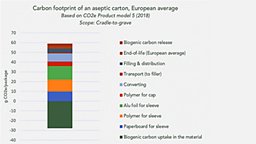
To illustrate the climate impact across the life cycle of an aseptic beverage carton, we here present the life cycle carbon footprint for a typical 1 litre Tetra Brik Aseptic with cap (HeliCap23).
The results show the cradle-to-grave carbon footprint of the carton, including raw material production, transport of raw materials, converting, transport of packaging materials to filler, filling and distribution, and end-of-life.
The calculations are based on industry average data and for European conditions. For production of liquid packaging board average data as presented by The Alliance for Beverage Cartons and the Environment is used, for plastics data as presented by Plastics Europe is used and for aluminium foil data as presented by European Aluminium Association is used. For the converting operations global average data from Tetra Pak's GHG reporting is used representing the performance in 2016. The impact of the transport of raw materials to the converting factory is included in the converting result and based on European average data. For the transport of packaging materials to the filler, average modes and distances as presented by ACE are applied. Forming and filling of the package are based on typical performance data and global average data for electricity. The end-of-life settings are based on average European waste management conditions based on statistics from 2016, with 47% recycling and 29% energy recovery. Landfill has been modelled for the remaining part. The 'cut-off' method has been used when modelling end-of-life: no environmental burdens nor credits have been included in the results for cartons going to recycling or incineration with energy recovery.
The 'biogenic carbon uptake in the material', as presented separately in the results, is an estimate of the amount of carbon that is stored in the carton when leaving the Tetra Pak converting factory gate. Growing plants capture and store carbon from the atmosphere. When the wood fibre is processed into paperboard the carbon continues to be stored in the carton. 'Biogenic carbon release' includes the amount of carbon that is released at end-of-life, if not recycled or energy recovered (in these cases the cut-off method has been applied as described above). To get a net result, including both fossil and biogenic CO2, the carbon footprint impact and the biogenic carbon uptake and biogenic carbon release should be summed.
The calculated results are not exact; they are indicative and based on several simplifications. To get the exact CO2e footprint of a package you need to know its specific material composition, in which converting factory it was produced and whether raw materials were brought to Tetra Pak by train or truck. We have used the most common material specification as the basis for the calculation of the results.
Package specifications and weights vary locally and with product protection requirements. CO2e footprint data will necessarily change over time as methodologies and data are refined.
The results should not be used to support comparative claims made to the public. Any such use would fall outside of the requirements of the relevant ISO standards.
The results are sourced from Tetra Pak's internal tool (CO2e Product Model version 5, 2018). The carbon footprint of this product has been certified by the Carbon Trust.

1 A lifecycle assessment (LCA) is unique to the market(s) for which it was commissioned and the conditions under which it was conducted. This means that the results are not universally applicable and may not be extrapolated beyond the original study scope.