
How we do business with you
What happens when you enquire about a membrane filtration unit? Let us walk you through the process.
How we do business with you
What happens when you enquire about a membrane filtration unit? Let us walk you through the process.
Expert advice on membrane filtration
How to reduce transportation costs and increase throughput
How to achieve high whey protein purity
Processing of whey after cheese production is one of the most common filtration applications.
The whey can be used for high-value protein products such as infant formula, sports and senior nutrition.
How to achieve high protein levels without additives
High-protein product like skyr, Greek yoghurt, labneh and quark are seen as superfoods by many health-conscious consumers.
Learn how to achieve high-protein levels without adding milk protein powder.
How to recover 90% of spent cleaning liquids
Recovering cleaning liquids for reuse can save money by using fewer chemicals, less energy, less water, and producing less wastewater.
How to ensure efficient operation of your filtration unit
How do you get the most out of raw materials, keep operating costs down, and minimise the environmental footprint?
One answer is our global membrane filtration service.
How to choose the right membranes for your needs
Membranes are key to the performance of your membrane filtration unit.
We know how to help you find the right membranes for your products, and we source from all suppliers.
Seamless cooperation for optimal commissioning
Recognising that commissioning is critical to long-term performance, Mammen Mejerierne (which translates to Mammen Dairies) trusted our experienced team to oversee every detail, from installation and testing to fine-tuning the system for optimal efficiency from day one.
Thanks to this seamless commissioning experience and the ongoing support that followed, Mammen Mejerierne gained confidence in their investment, knowing their filtration unit was built for reliable, day-to-day performance.
Explore how we collaborated during the commissioning phase to achieve optimal performance.


Learn the basics of membrane filtration
Is membrane filtration new to you?
Learn how a spiral-wound membrane is constructed
Start your journey with this first video.
Here, you’ll learn how spiral-wound membranes are constructed.
We’ll also walk you through terms and definitions within membrane filtration.
Learn about the four different separation processes
We’ll walk you through reverse osmosis, nanofiltration, ultrafiltration, and microfiltration and which membranes to use for lactose reduced products, bacteria & spore removal, and other applications.
See a spiral-wound membrane filtration unit in action
We use the example of protein concentration for dairy products with high protein/low fat content, tailormade milk drinks, and protein powder for nutritional purposes.
See how spiral-wound membranes work
Spiral-wound membrane filtration is one of the key technologies behind innovative food solutions. Explore the features of spiral-wound membranes.
See a ceramic membrane filtration unit in action
You can use the unit for 99,9999% removal of bacteria and spores in chilled milk and in cheese milk to obtain premium quality end products with extended shelf life.
See a plate and frame membrane filtration unit in action
Typical products produced by using this technology are high-viscosity dairy and plant-based products such as skyr, Greek yoghurt, labneh, cream cheese and yoghurt-style plant-based products.


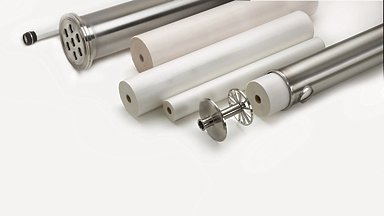
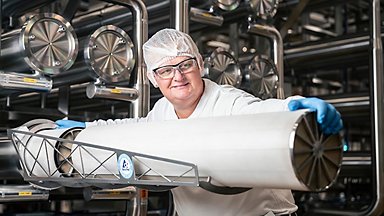
Membrane filtration processes
Within the dairy industry, four different membrane filtration processes are used: microfiltration (MF), ultrafiltration (UF), nanofiltration (NF), and reverse osmosis (RO). The figure illustrates which milk and whey components can be concentrated by means of each process, depending on the density of the membrane.


