
Driven by purpose
At Tetra Pak, our purpose is to make food safe and available, everywhere, while protecting what’s good: food, people and the planet.
We provide advanced food systems – from product creation and recipe testing to processing, filling, packaging, logistics, services and beyond.
In today’s world, where we face the immense, interconnected challenges of feeding a growing population while protecting our natural resources and combating climate change, our Strategy 2030, guided by our purpose, is essential in shaping the company we want to be in the future.
We are committed to leading the sustainability transformation through low‑carbon, circular-economy solutions and to enhancing sustainability across the supply chain.

Our Double Materiality Assessment
In 2025, we continue to refine our Double Materiality Assessment (DMA) to strengthen its role in strategy and risk management. The refinement deepened the identification of sustainability-related impacts, risks, and opportunities across our value chain. The DMA now provides clearer, evidence-based priorities and stronger integration with risk management and strategy, supporting more informed decision-making and long-term business resilience.
This year’s refinement drew on deeper Human Rights Due Diligence (HRDD) analysis, aligned with the UN Guiding Principles on Business and Human Rights (UNGPs) and the OECD Guidelines for Multinational Enterprises on Responsible Business Conduct, and updated climate and nature scenario work. These, along with other new input, provides a more informed view of where sustainability matters arise across our value chain.
The consultative process that defined our material impacts, risks and opportunities followed a structured five step framework to ensure consistency and continuity in the process, and aligning to the requirements under ESRS 1.
Process of our double materiality assessment

Understand
We mapped relevant business activities and locations across our value chain, taking short, medium, and long‑term timeframes1 into account, and collected relevant information sources, such as our risk register, sustainability assessments and stakeholder engagement.

Identify
Identify impacts, risks and opportunities in our value chain, and map to the business activities in our value chain and the relevant ESRS topics.
Impacts may be actual or potential, and either negative or positive.2 The negative impacts that have been identified are on outcome of our due diligence process. Key steps of this process include:
Mapping actual and potential impacts on people and the environment as a result of our business activities and relationships throughout the value chain.
Integrating outcomes from dialogue with suppliers and customers, interviews with external experts and internal stakeholders, and most importantly engagement with affected workers or communities.
Once impacts were identified and assessed through the due diligence process, they were fed into the DMA.
Risks and opportunities: Sustainability‑related risks and opportunities are identified through our Risk Management, Strategy and DMA processes. The identification of impacts and dependencies further supports the identification of related risks and opportunities.

Assess
Assess impacts, risks and opportunities.
The impact materiality assessment assesses impact based on their severity (scale, scope & irremediability) and likelihood in line with the due diligence methodology.3 Financial materiality assessment for risks and opportunities is based on potential financial effect and likelihood in line with our Risk Management assessment methodology.

Evaluate & determine
Determine material IROs based on a threshold for impact and financial materiality.
To determine the material IROs, we have set materiality thresholds for the quantitative assessments and where relevant, our internal experts may apply qualitative judgement. Improvements in our process since 2024 resulted in the identification of several new material IROs, particularly in biodiversity, water, circularity and social topics. A small number of IROs previously considered material were reassessed and no longer met the materiality threshold. Material IROs were aggregated to help structure sustainability reporting and strategic decisions.

Communicate and report
Document final results and communicate internally and externally.
The final output of the DMA was documented and communicated internally as well as translated into reporting requirements that are disclosed on in this report. On the next page, you can see our material ESRS sub‑topics mapped across our entire value chain.
Impacts, risks and opportunities across our value chain
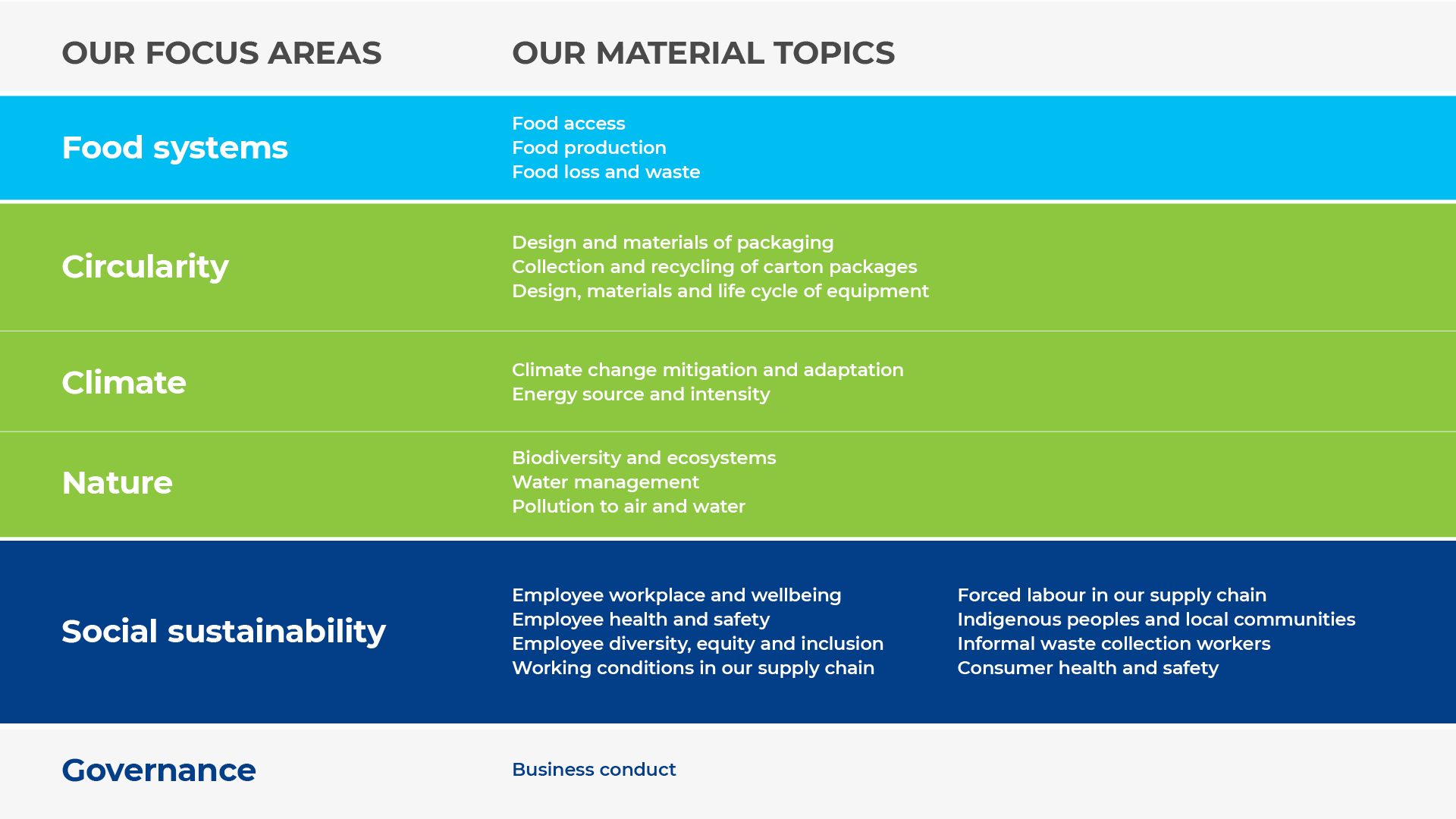
Our material IROs, as identified through the Double Materiality Assessment (DMA), are presented by ESRS14 material sub‑topic and mapped across our value chain. Our value chain map illustrates where these IROs arise within our business model, including upstream activities (such as raw material sourcing and supplier related processes), our own operations and downstream activities linked to customers, product use and end‑of‑life management.
External recognition helps us to benchmark our sustainability efforts:

We received a Platinum medal in 2026, placing us the Top 1% of companies assessed by EcoVadis in the 12 months prior. It reflects the quality of our sustainability management system and demonstrates a commitment to promoting transparency throughout the value chain.

We have been named one of Europe’s Best Employers 2025 by the Financial Times, ranking in the top ten for our sector, in recognition of our ability to provide a workplace experience that empowers employees to make an impact. We were also recognised in the 2026 Financial Times Diversity Leaders ranking which assesses companies on criteria such as gender balance in leadership, inclusion practices and openness to all forms of diversity.

Our comprehensive Approach to Nature Framework won the Environmental Initiatives Award and was recognised as an industry-leading strategy for addressing biodiversity loss and water security across the entire value chain.

We were named the inaugural Servitization Innovation Leader of the Year by the Advanced Services Group (ASG) in recognition of our pioneering role in applying advanced, outcome‑based service models to the food and beverage sector.

We have been recognised for sustainability leadership by CDP, earning a B score for our work in Climate Change and an A- score for our work in Forestry and Water Security. For two consecutive years, we also earned the A‑list rating for supplier engagement in sustainability.

We won the Food Manufacturing Innovation Award from Fi Europe for our Tetra Pak® Air Jet Cleaning System for Powder and were also named a finalist in the Future Foodtech Innovation category of our Whole oat beverage line.
How we verify our sustainability approach
Verification is essential to our sustainability process. Our GHG emissions data has received third-party limited assurance since 2013, and our direct operations water data has received limited assurance by a third party since 2023.
We also have a Sustainability Advisory Panel, formed in 2020, to provide independent strategic insight, guidance and assistance focused on sustainability and innovations in pursuit of our purpose. Its members are all independent experts with experience across a broad range of sectors, ranging from academia to civil society organisations.
Governance
The Tetra Pak Executive Leadership Team (ELT) is the decision‑making body of Tetra Pak, operating within the scope of the Tetra Pak Charter of Responsibility. The ELT is responsible for leading, developing and managing the Tetra Pak Group.


Related links and documents
1 Timeframes used were – short‑term = < 1 year, medium‑term = 1‑5 years, long‑term = > 5 years.
2 Positive Impacts: These refer to beneficial effects that an undertaking has or could have on people or the environment. Positive impacts can be either actual or potential. Negative Impacts: These are adverse effects that an undertaking has or could have on people or the environment. Negative impacts can be actual or potential, short‑term or long‑term, intended or unintended, and reversible or irreversible. Actual Impacts: These are impacts that have occurred or are occurring as a result of the undertaking’s activities or its business relationships. Potential Impacts: These are impacts that could occur but have not yet materialised. They represent possible future effects resulting from the undertaking’s activities or its business relationships.
3 Scale – how severe or beneficial the impact is or would be for people or the environment Scope – how widespread the impact is, based on extent of the damage or amount of stakeholders affected Irremediability – when the impact is negative, how hard it is to counteract or remedy the harm (N/A for positive impacts) Likelihood – chance of a potential impact occurring (always scored as ‘certain’ for actual impacts).
4 This means creating cartons that are fully made of renewable or recycled materials, that are responsibly sourced, therefore helping protect and restore our planet's climate, resources and biodiversity; contributing towards carbon-neutral production and distribution; are convenient and safe, therefore helping to enable a resilient food system; are fully recyclable.