Avantages
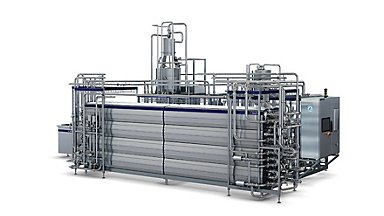
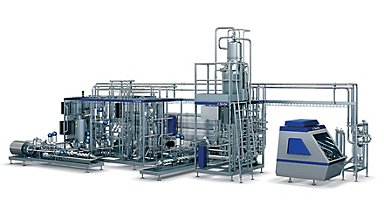
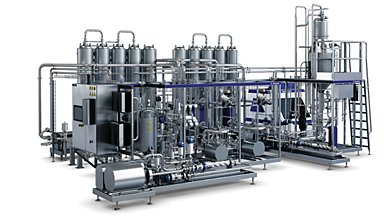
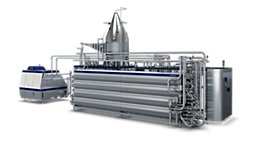
Tetra Therm® Aseptic VTIS représente depuis longtemps le système de traitement direct UHT de classe mondiale, pour les produits aseptiques. Il s'agit d'une unité de traitement aseptique pour le traitement UHT continu avec injection directe de vapeur. Il est essentiellement destiné aux produits thermosensibles et à faible taux d'acidité, tels que le lait, le lait enrichi, la crème, lait de soja, les produits laitiers formulés, le mélange pour crème glacée, les desserts à base de lait, ainsi que les produits à longue durée de conservation (ESL). Ce processus est également adapté aux produits lisses tels que les soupes, les sauces, les crèmes non laitières et autres produits à base de fécule, et peut traiter des morceaux de petite taille.
Données clés
Système de traitement UHT direct continu des produits alimentaires liquides dans des conditions aseptiques
Capacité
2 000 l/h à 30 000 l/h (capacité variable 1:2 standard)
Applications
Lait, lait enrichi, crème, lait de soja, produits laitiers formulés, mélange pour crème glacée, produits longue conservation (ESL), desserts laitiers, crème non laitière, et soupes et sauces fluides.

Qualité supérieure avec le procédé UHT direct
- La charge thermique globalement faible minimise l'impact sur le goût, la couleur et la valeur nutritionnelle
- Convient à une large gamme de produits laitiers et d'origine végétale
- Efficience opérationnelle la plus élevée pour les systèmes UHT directs du marché
Caractéristiques
Injection de vapeur
Qualité et efficacité des produits
De la vapeur est injectée rapidement dans le produit et le chauffe instantanément en le faisant passer de 80º à la température UHT. Il est ensuite soumis à une phase de condensation (de seulement 0,1 seconde) avant qu'il ne retrouve une température équilibrée. L'association d'une température de stérilisation élevée et d'un temps de chauffage court garantit la désactivation des micro-organismes et des spores, et réduit l'impact sur le goût et la couleur du produit. Le processus génère également un très faible dépôt, et offre par conséquent une facilité de nettoyage exceptionnelle, ainsi que des temps d'interruption et des coûts de nettoyage réduits.
Infusion de vapeur
Réduit l'impact sur la saveur, la couleur et la consistance du produit
Le principe de base de l'infusion de vapeur est de chauffer un produit en le faisant passer au travers d'une atmosphère de vapeur. Le système de diffusion du produit peut varier, mais la taille des gouttes de lait obtenues doit être uniforme, afin de préserver un taux de transfert thermique régulier. Le processus d'infusion de la vapeur est similaire au système d'injection de la vapeur mais plus doux (moins de cisaillement), ce qui confère une meilleure stabilité au produit. Il est donc parfait pour la crème à fouetter et les produits contenant des agents stabilisants. Cependant, il nécessite plus de vapeur, de l'eau de refroidissement et occasionne des pertes de produits supplémentaires, ce qui le rend 4 à 8 % plus onéreux que le processus d'injection de vapeur.
Refroidissement flash
Pertes de produits minimales, exploitation et maintenance efficaces
Le refroidissement flash, qui a lieu dans la cloche sous vide équipée d'un condensateur, permet un refroidissement rapide du produit. Un vide partiel est assuré par une pompe et contrôlé pour garantir l'évaporation de la même quantité d'eau que celle précédemment ajoutée sous forme de vapeur. Le large diamètre et la forme conique, ainsi que la longue distance entre l'entrée du produit et la sortie de la vapeur, garantissent un transfert lent et une perte minimum des saveurs.
Le réservoir à vide compact avec condensateur intégré vous permet d'effectuer une pré-stérilisation et un nettoyage rapides et efficaces. Il est également conçu pour offrir un accès aisé en cas d'inspection, d'entretien et de maintenance.
Système à double bac de lancement
Faibles pertes de produits
Un bac est destiné au produit et l'autre à l'eau. Ce dernier - un bac de lancement NEP - est utilisé comme bac d'eau secondaire lors de la permutation entre l'eau et le produit, ce qui permet d'obtenir une transition précise entre l'eau et le produit. De plus, une section réduite à la base raccourcit la phase de mélange. Le remplissage et la vidange avec contrôle du volume réduisent les pertes de produits à moins de 150 litres par cycle de production de 15 000 litres.
Panneaux de protection de l'échangeur thermique
Un formidable potentiel en matière d'économie d'énergie
Les panneaux de protection construits autour du Tetra Pak® Echangeur de chaleur tubulaire isolent l'équipement et contiennent la chaleur. Ils permettent de réaliser jusqu'à 6 % d'économies d'énergie par rapport aux échangeurs thermiques sans panneaux. Avec une isolation supplémentaire, les économies peuvent atteindre 11 %. Les panneaux augmentent également la sécurité de l'opérateur en réduisant les risques de contact avec les surfaces chaudes.
Système de têtes flottantes de l'échangeur thermique
Longévité améliorée et efficacité exceptionnelle
Le produit aseptique présent dans les canalisations internes du Tetra Pak® Tubular Heat Exchanger circule en étant soumis à une pression supérieure à celle du produit non traité se trouvant du côté calandre. Un système de têtes flottantes autorise une dilatation thermique, ce qui réduit considérablement le risque de dégâts consécutifs à une fissuration, et par conséquent la perte de stérilité. En plus de prolonger la durée de vie, ce système améliore la sécurité alimentaire.
Solution de chauffage combinée
Réduit les coûts d'exploitation
Au lieu d'acheter deux différentes unités, vous pouvez acheter un modèle combiné prêt à l'emploi ou mettre à niveau votre équipement existant pour gérer les méthodes de chauffage directe et indirecte. Lors de la fabrication de produits haut de gamme, le mode VTIS (UHT direct) offre un goût et une couleur parfaits. Lors de la fabrication de divers produits (de qualité à la fois standard et supérieure), il est possible de faire fonctionner l'équipement en mode Flex (chauffage indirect) ou Plus (en associant le chauffage direct et indirect) et par conséquent de réduire le coût des moyens de production.
Clapet automatique
Pour des durées de fonctionnement supérieures
Les clapets de l'homogénéisateur absorbent les variations de pression et les chocs avant et après l'homogénéisateur. Le remplissage automatique d'air préserve le coussin d'air dans le clapet de l'homogénéisateur pour garantir un fonctionnement régulier. Sans ce coussin, il se produirait des vibrations et de la cavitation, ce qui réduirait la durée de fonctionnement. Un NEP entièrement automatisé est fourni, ce qui améliore la sécurité de l'opérateur, l'hygiène et optimise encore davantage le cycle de production.

Manuel de transformation des produits laitiers
Le Manuel de transformation des produits laitiers est un condensé de notre vaste savoir-faire ; il fournit des informations détaillées et faciles à comprendre sur les processus de fabrication.
%20(1)?wid=384&hei=216&fmt=jpg&resMode=sharp2&qlt=85,0&op_usm=1.75,0.3,2,0)