
Flexible heat treatment for every food production need
Tetra Pak® Tubular Heat Exchanger is the perfect choice for heat-treating a full range of foods, including the most viscous products. A robust construction, able to tolerate up to 200 bar of pressure, capably handles viscosity. It is also ideal for low-viscous products, especially when high flow rates are required.
Combining straight and corrugated tubes, Tetra Pak Tubular Heat Exchanger offers optimal performance, long production runs and low maintenance costs. Short residence times ensure high product quality and low product losses. The unit is built for extended lifetime and meets the most exacting food safety standards.
Complementing the standard Tetra Pak Tubular Heat Exchanger C are the compact Tetra Pak Tubular Heat Exchanger S and SA, whose small footprint makes them ideal when space is limited.


Quick facts
Tetra Pak® Tubular Heat Exchanger has been a value driver for the liquid food industry for decades. It offers high-class performance, long running time, high energy efficiency and low maintenance costs.
The ultra-compact format saves valuable plant space and is designed for easy service and maintenance. The long six-metre tube modules mean fewer bends and improved space utilisation.
3-A certification is available for many types of applications and EHEDG certification for product-to-water (P2W) applications, giving independent proof of the unit’s excellent cleanability and hygienic design.
Capacity: 200 l/h to 120,000 l/h.
Applications: Food products from low to high viscosity, with or without particles, and products containing fibre or pulp.

Features
Floating protection system
Long service lifetime and enhanced food safety
The inner and outer tubes and the connections in the heat exchanger are floating, not fixed or welded. This allows for thermal expansion or contraction in the tubes without the risk of cracking. It eliminates the risk of product contamination (due to expansion cracking), enables the inspection of all parts, and secures easy exchangeability of parts.
Modular design
Flexibility to adapt design to needs
The frame, tubes and other components parts of the heat exchanger are assembled in such a way as to allow for easy dismantling and rebuilding. This makes it possible to customize the heat exchanger for different recipes, capacities, and to run different products. As a customer, you can choose what to focus on. It's not only about which product you plan to produce; the design also offers flexibility in terms of e.g. energy consumption vs. investment cost.
Heat exchanger protective panels
Great energy savings potential
Protective panels built around the Tetra Pak® Tubular Heat Exchanger encapsulate the equipment and contain the heat. This gives up to 6% savings on energy consumption compared to heat exchangers without panels. With added insulation, savings can increase to 11%. The panels also increase operator safety since they reduce the risk of contact with hot surfaces.
Product-to-product heat recovery
Low energy consumption
In this type of heat exchanger, product that has already been heated can be run past cold incoming product in order to pre-heat it. This reduces the amount of energy needed to bring the new product up to pasteurization temperature. It is possible thanks to the floating protection system, which eliminates the risks of cracks, and therefore cross contamination of product.
Long, floating tubes
Reduces food safety risks
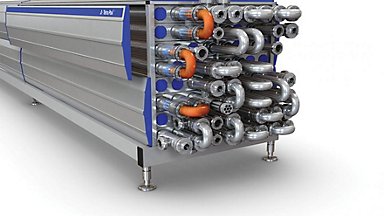
Our tubular heat exchangers with 6 meter tubes are the safest on the market. Their floating design makes it possible to offer compact and efficient heat exchangers without any risk of cracks in the tubes. The heat exchangers are extended horizontally, rather than being stacked vertically, which also enables easy access for maintenance.
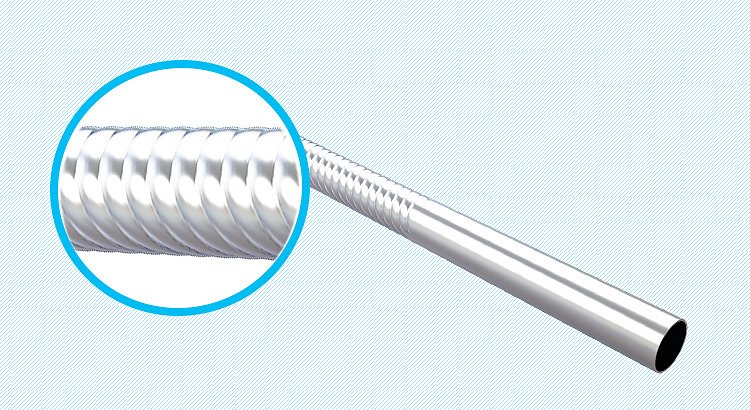
Patent-pending Q corrugation
Lower your electricity costs
Our unique, patent-pending Q corrugation leads to a 40% reduction in pressure drop, which can reduce your electricity consumption for the heat exchanger pump by up to 40%. And with less pressure required, you can use a smaller, cheaper pump than was previously required, saving you further costs and lowering your total carbon footprint
Options
Spring box
Enables free product flow and superior hygiene
An optional patented spring box holds the heat exchanger tubes in place without any need for inner dividers or similar devices. By removing these internal barriers, the spring box facilitates free product flow and eliminates potential hygiene blind spots. The spring box is ideal for products containing fibres, but works well for other applications too.
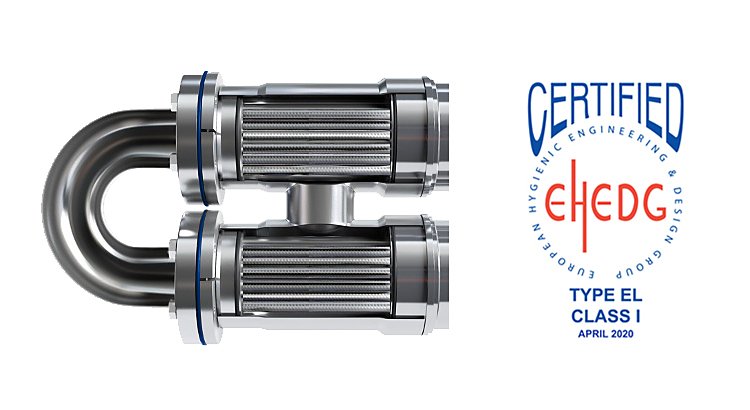
EHEDG CERTIFICATION
First to offer EHEDG certification
EHEGD certification is an option on a selected range of Tetra Pak Tubular Heat Exchangers, namely CM models for product-to-water (P2W) applications. Now popular CM multitube modules can be EHEDG-certified, giving independent proof of excellent cleanability and hygienic design.
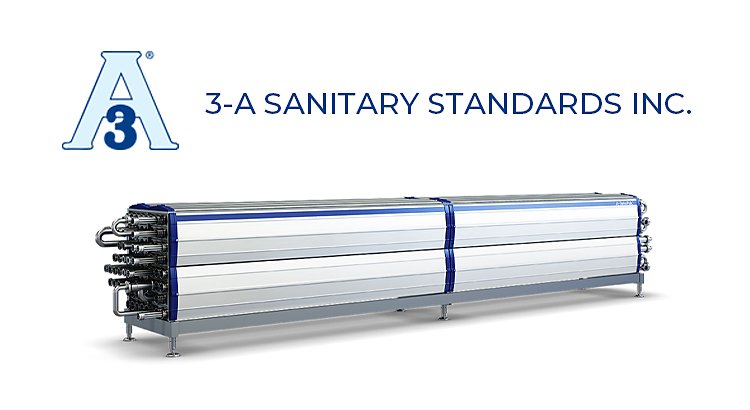
3-A compliance
3-A compliance
In 2016, we met the American 3-A standard after the introduction of new smooth welding technology. Their tough requirements are that all product contact surfaces can be mechanically cleaned and dismantled easily for manual cleaning or inspection. 3-A compliance is optional for all our product-to-product (P2P) tubular heat exchangers.

Longer running times
Increase your production efficiency
Where pressure is a limiting factor for running time, the new Q corrugation pattern helps achieve a longer running time (CMR THE only). And with longer running times, you’ll need less downtime for cleaning, saving you both time and money. This increased plant efficiency also extends to production planning and energy consumption.

Space-saving design
Save valuable floor space with compact design
Tetra Pak® Tubular Heat Exchanger S and SA deliver high heat transfer performance in a remarkably compact format. With shorter tubes, minimal spacing and flexible mounting options, they fit where standard units cannot – even inside existing equipment or on walls. You economise on floor space, simplify line integration and gain new layout possibilities without compromising efficiency.
The Magic inside: Tetra Pak Tubular Heat Exchangers
View video and discover the magic inside Tetra Pak Tubular Heat Exchangers!
The Magic inside: Tetra Pak Tubular Heat Exchangers
View video and discover the magic inside Tetra Pak Tubular Heat Exchangers!
Tetra Pak® Tubular Heat Exchanger with P2P technology
P2P technology offers major energy-saving potential. Key features, including a smart crevice-free weld and innovative spring box, offer unsurpassed hygiene.


1) Based on an example for a 15,000 l/h unit for UHT milk (140 °C sterilizing temperature), comparing our design using product-to-product heat recovery (P2P) with a 6-metre tube module length to a traditional design using product-to-water heat recovery (P2W) with a 3-metre tube module length. Our design uses 60% fewer tube modules (= the traditional design needs 2.5 more modules) and the heat loss is 67% lower in our unit if it is insulated* (= the heat losses in the traditional design is triple that of our design). The heat losses in our insulated unit is 53 kg steam per hour less than in the unit with a traditional design. At 6,000 h production per year and 0.03913 EUR per kg steam this equals a saving of 12500 € per year (rounded from 12443).
2) Illustrative example: a tomato purée producer in Europe. Comparison between 150 bar versus 100 bar.
Media consumption:
- Fresh/process water (EUR/m3): 2.95
- Steam (EUR/kg): 0.04
- Electricity (EUR/kWh): 0.1
Production:
- Line capacity: 5,500 kg/h
- Product: Tomato purée 24 Bx
- Production schedule: 17 hours/day,
5 days/week, 46 weeks/year,
5 CIPs/week, 5 pre-sterilisations/week - Operators: N/A
Production data:
- Viscosity: High
- Specific heat: 3.8 kJ/kg*K
- Density: 1.1 kg/l
Raw material cost: EUR 1,500/1,000l product