メリット
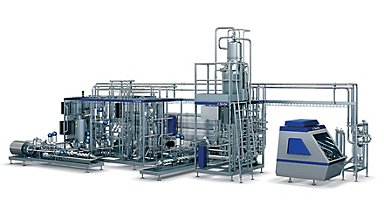
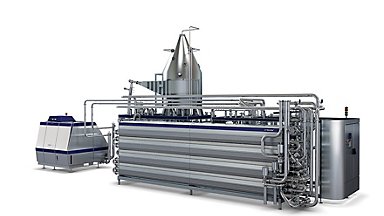
テトラパック® 間接 UHT ユニットは、乳製品の超高温殺菌処理をスマートかつ滑らかに行う食品加工処理ユニットです。このユニットは、アセプティック用に設計されたチューブ式熱交換器で、常温保存が可能な製品を製造する際に間接的な加熱に使用されます。
主なデータ
無菌状態で液体食品の連続 UHT 加熱処理
処理能力
1,000 ~ 40,000 リットル/時
用途
テトラパック間接 UHT ユニット DC は、牛乳、色物乳飲料、クリーム、ヨーグルトドリンク、バッファローミルク、調製乳製品などの乳製品や、豆乳などのその他の低酸性製品に適しています。ジュース、紅茶、コーヒーなどの乳製品以外の飲料との組み合わせも可能です。

Smart value at the right capacity
- Robust and reliable technology that offers optimal value for money
- Safety in focus at all times
- Future-proof: continuous upgrade opportunities provide the flexibility to grow for tomorrow

特長

Direct steam in the final heater
Smart base for longer runs at lower costs
The streamlined Tetra Pak® Indirect UHT unit uses direct steam in the shell side of the final heater, which enables production run times of up to 8 hours. The steam pressure is accurately controlled to prevent product burning. For run times of up to 16 hours, an optimized set-up with a temperature-controlled, protein-denaturation holding tube and hot water circuit option is available.
Product-to-product regeneration
Optimized steam consumption
Low-loss balance tank
Minimizes product loss
A smart balance tank configuration makes it possible to remove the maximum amount of water before product enters the tank, thus reducing the mix of water and product. This method lowers the number of litres in the mix phase by over 50%, leading to a significant reduction in product losses.

Closed pre-sterilization loop
Better value with reduced energy consumption
During pre-sterilization, hot water is circulated in the module. By directing the hot water over the pressurized side as a closed loop, you eliminate the need for cooling in the return line. This shortens start-up time and reduces utility consumption.
Heat exchanger protective panels
Great energy savings potential
Protective panels built around the Tetra Pak® Tubular Heat Exchanger encapsulate the equipment and contain the heat. This gives up to 6% savings on energy consumption compared to heat exchangers without panels. With added insulation, savings can increase to 11%. The panels also increase operator safety since they reduce the risk of contact with hot surfaces.
Heat exchanger floating protection system
Longer lifetime and exceptional efficiency
Aseptic product in the inner tubes of the Tetra Pak® Tubular Heat Exchanger flows at a higher pressure than the untreated product on the shell side. A floating protection system allows for thermal expansion, greatly reducing the risk of damage from cracking, and consequent loss of sterility. In addition to extending lifetime, this improves food safety.