
Fördelar
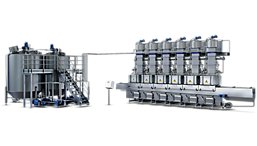
Med Tetra Pak® Casomatic-system SC7-modulen är det möjligt att producera högkvalitativ ost och vassle effektivare än tidigare. Tetra Pak Casomatic-system SC7 erbjuder ett helautomatiskt, kontinuerligt system för avrinning av vassle, förpressning, exakt blockformning och formfyllning i en följd.
Tetra Pak Casomatic-system SC7 lämpar sig för tillverkning av hårda och halvhårda ostar. Om man lägger till ett filter för vassleavrinning kan även gryniga ostar tillverkas.
Den höga kapaciteten per kolonn beror på att ett flexibelt system för vassleavrinning tillämpas. När man tillverkar en enda oststorlek är Tetra Pak Casomatic-system SC7 det självklara valet.
Tetra Pak Casomatic-system SC7 ger följande fördelar:
- Effektiv lösning.
- Långa produktionssessioner.
- Tillförlitlig prestanda.
- Utmärkt vasslekvalitet.
- Exakta fukthalter.
- Enastående viktprecision.
- Hög ostkvalitet.
- Förbättrad miljöprestanda.

Efficient, effective medium to high volume cheese production
- High-quality cheese and whey production thanks to the gentle treatment of cheese and his self-cleaning functionality
- Maximum yield, with tightly controlled process that eliminates weight and moisture variations
- Certified machinery with hygienic operation enhances food safety, and enables shorter cleaning cycles
Funktioner

Dimple jacket cooling
Reduces variations in moisture content
A dimple jacket is wrapped around the conical part of the buffer tank, cooling the curd/whey mixture during filling, residence and emptying. This slows down the acidification process, thereby limiting the degree of variation in moisture content of the final cheeses from beginning to end of batch.
Buffer tank design
Ensures a consistent whey /curd ratio
Based on many years of accumulated expertise and experience, we’ve developed a buffer tank with the optimal inner dimensions and agitator to maintain an almost constant ratio of curd and whey and a constant curd particle distribution. This results in a curd mixture of uniform consistency to be fed into the casomatic system.
Drainage system
Controls the volume of whey that is drained off
The drainage system is divided into three perforated sections, gently draining off whey at each step until the desired amount (according to the pre-set recipe) has been removed - in order to create a stable, compact curd block. A regulating membrane valve is used to control the flow of whey and ensure the optimal amount is removed. The gentleness of the process keeps the product intact and minimizes losses.
Whey circulation system
Keeps the machine clean during production
A whey circulation system keeps the curd fines in the draining section in motion and prevents sedimentation. Flow dividers minimize curd build-up on the flanges of the inserts, limiting the growth of microorganisms during production and enabling a shorter CIP cycle.
Curd block forming
Gives cheese blocks with a high-quality appearance
Once cut from the curd bed, the curd block is gently transferred to the front of the machine. The mould is presented underneath the sluice plates, which open swiftly minimizing friction when transferring the block to the mould.

Automation system
Monitors production and compensates for disturbances
Our advanced control software is programmed to continuously monitor production and minimize the effects of any unexpected disturbances on the line. Since the composition of cheese changes rapidly, it is important to compensate for any deviation in production by e.g. adjusting cutting height or cooling the buffer tank. The control system does this automatically, without the need for any operator intervention.
Conveyor
Gentle handling
Presenting moulds to the columns, collecting curd blocks and transporting the filled moulds to the pressing system, the mould conveyor handles your product gently every step of the way. It includes a lifting buffering system to ensure the curd blocks land softly in the mould on the conveyor, and smooth transport from the columns to the presses.
Dosing chamber design
For more hygienic production
The enclosed dosing chamber is designed to allow whey to flow down from top to bottom, preventing any curd build-up. This continuous flow of whey is combined with regular flushing to minimize bacterial growth and enable longer production runs.


