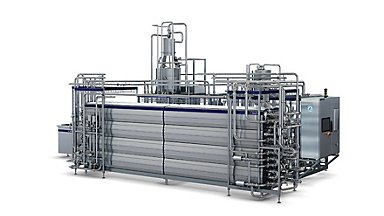
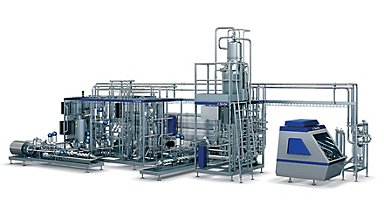
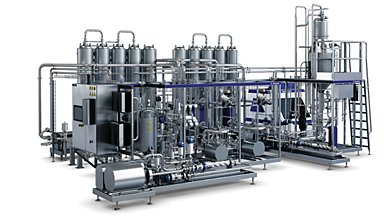
Tetra Therm® Aseptic VTIS har länge stått för högkvalitativ direkt UHT-behandling av olika aseptiska produkter. Det är en aseptisk processenhet för kontinuerlig UHT-behandling med direktinsprutning av ånga. Tetra Therm Aseptic VTIS används framför allt för värmekänsliga produkter med låg syrahalt som mjölk, berikad mjölk, grädde, sojamjölk, berikade mejeriprodukter, glassblandning, mjölkbaserade desserter och produkter med längre hållbarhetstid (ESL-produkter). Processen lämpar sig även för släta produkter som soppor, såser, mjölkfri grädde och andra stärkelsebaserade produkter, maskinen kan hantera mindre partiklar.
Snabbfakta
System för kontinuerlig UHT-behandling för flytande livsmedelsprodukter under aseptiska förhållanden.
Kapacitet
2 000 liter/timme till 30 000 liter/timme (variabel kapacitet 1:2 är standard)
Tillämpningar
Mjölk, berikad mjölk, grädde, sojamjölk, berikade mejeriprodukter, glassblandning, produkter med längre hållbarhetstid (ESL-produkter), mjölkbaserade desserter, mjölkfri grädde och släta soppor och såser.
Steam injection
Steam is injected rapidly into the product, instant heating it from 80° to the UHT temperature, followed by condensation (only 0.1 seconds) and temperature equilibrium. The combination of a high sterilization temperature and a short heating time ensures that microorganisms and spores are deactivated with minimal impact on the product's taste and colour. The process also involves very low fouling, which in turn means outstanding clean-ability, less downtime for cleaning and overall lower cleaning costs.
Steam infusion
The basic principle of steam infusion is to heat a product by passing it through an atmosphere of steam. The product's spreading system may vary, but the resulting milk droplet size must be uniform, to maintain a steady heat transfer rate. The steam infusion process is similar to steam injection system but gentler (less shear) which gives greater product stability. It is therefore especially good for whipping cream and products containing stabilizers. However, it requires more steam, cooling water and additional product losses which leads to a 4 – 8 % higher operating cost than steam injection.
Flash-cooling
Flash cooling – which takes place in the condenser-equipped vacuum vessel - enables rapid cooling of the product. Partial vacuum is maintained by a pump and controlled to ensure the same amount of water is evaporated as was earlier added as steam. The large diameter and the conical shaped top, in combination with the long distance between the product inlet and vapour outlet ensure low carry over and minimal loss of flavour.
The compact vacuum vessel with built-in condenser gives you quick and efficient pre-sterilization and cleaning. It is also designed for easy access for inspection, service and maintenance.
Double balance tank system
There is one tank for product and another for water. The latter – a CIP header batch tank - is used as a second water tank at water-to-product change over, enabling a sharp water-to-product interface. In addition, a reduced bottom diameter shortens the mix phase. Volume-controlled filling and emptying minimise product losses to less than 150 litres per production run of 15,000 litres.
Heat exchanger protective panels
Protective panels built around the Tetra Pak® Tubular Heat Exchanger encapsulate the equipment and contain the heat. This gives up to 6% savings on energy consumption compared to heat exchangers without panels. With added insulation, savings can increase to 11%. The panels also increase operator safety since they reduce the risk of contact with hot surfaces.
Heat exchanger floating protection system
Aseptic product in the inner tubes of the Tetra Pak® Tubular Heat Exchanger flows at a higher pressure than the untreated product on the shell side. A floating protection system allows for thermal expansion, greatly reducing the risk of damage from cracking, and consequent loss of sterility. In addition to extending lifetime, this improves food safety.
Combined heating solution
Instead of buying two different units, you can purchase a readymade combi model or upgrade your existing equipment to manage both direct and indirect heating methods. When producing premium products, the VTIS mode (direct UHT) gives optimal taste and colour. When producing a variety of products (i.e. both standard and premium quality) it is possible to run the equipment in Flex mode (indirect heating) or Plus mode (combining direct and indirect heating) and thereby lower utilities costs.
Automatic damper
Homogenizer dampers absorb pressure variation and shocks before and after the homogenizer. Automatic air refill maintains the air cushion in the homogenizer damper to ensure smooth operation. Without the air cushion, vibration and cavitation would occur and shorten the running time. Fully automated CIP is included - increasing operator safety, improving hygiene, and further optimizing the production cycle.
Dairy Processing Handbook är en sammanfattning av våra omfattande kunskaper och ger djupgående, men samtidigt lättförståelig, information om tillverkningsprocesser.